When a Relaunch Sparked a Revival: Revisiting Anita's BBC Radio 4 Interview By The Partially Sighted Society
We recently uncovered the transcript of a BBC Radio 4 interview that, looking back, marks something of a turning point in the story of PSS. In March 2018, Chief Executive Anita Plant sat down with the network's flagship sight loss programme, In Touch, for what turned out to be a candid and wide-ranging conversation about the state of our charity.
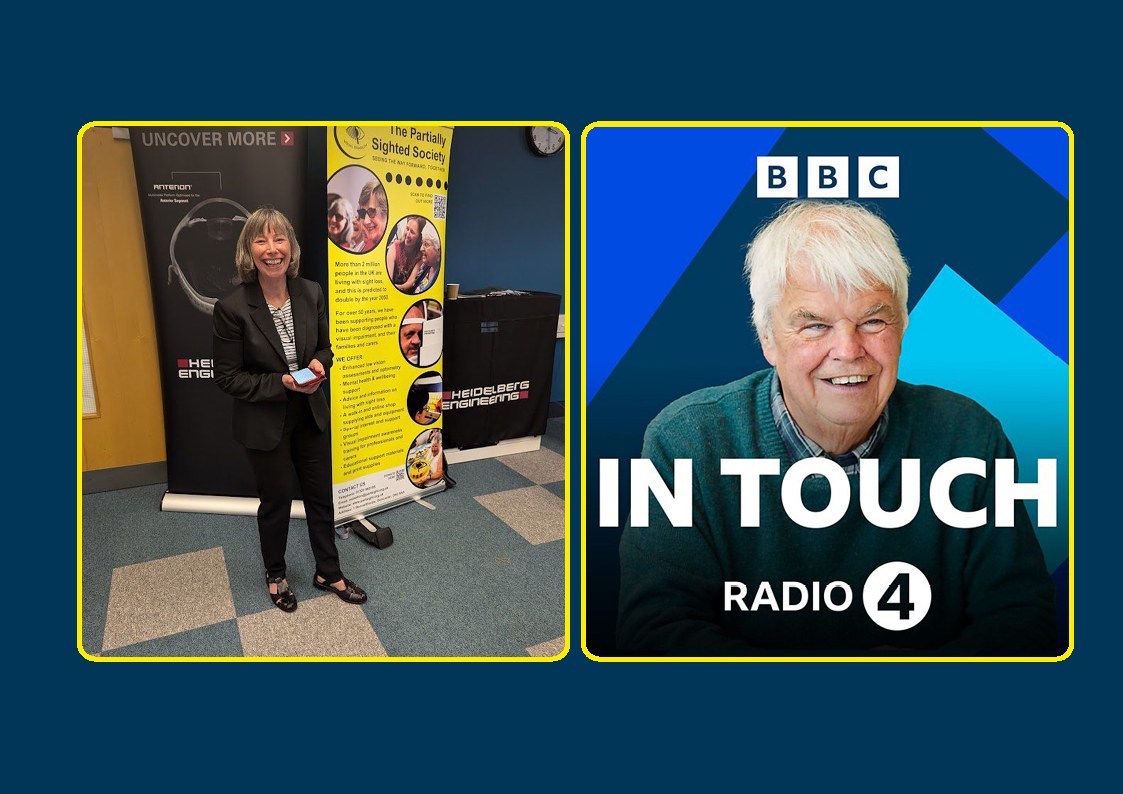
Presenter Peter White did not hold back. He pressed Anita on PSS's relatively low profile, noted that the organisation had been quieter than in previous decades, and probed the practical limits of what a tiny team based in Doncaster could realistically achieve. It was a fair challenge. Anita's response to whether PSS would be more visible in the future was characteristically measured: "I'm certainly going to give it a good try."
Seven years on, we think she has.
The story of how PSS arrived at that 2018 interview is one of difficulty, determination, and an extraordinary stroke of fortune. The charity had originally been based in London, but a prolonged lack of funding forced a painful reckoning: staffing was cut significantly, and PSS relocated to Doncaster. It was, by any measure, a moment of crisis.
Then, out of the blue, a legacy arrived. More than a million pounds, left by someone who had themselves benefited from PSS's services in earlier years, it changed everything.
The trustees had long held an ambition to establish a fully professional low vision service. Now, for the first time, they had the means to pursue it.
The legacy funded the purchase and renovation of a building in Doncaster, bringing it up to a liveable, accessible and workable standard, and filling it with the optometric equipment needed to deliver something genuinely exceptional. It was into this emerging operation that Anita joined in 2011, initially as Low Vision Services Manager, tasked with building an exemplary low vision clinic from the ground up. She became CEO in 2013, inheriting a team that, despite everything that had been built, still numbered just three people.
By the time of the 2018 broadcast that number had reached four, with everyone covering multiple roles. Anita was running the organisation, conducting assessments, and leading outreach work. The conference that preceded the interview, PSS's first national gathering in many years, was described by Anita on air as a relaunch. It was an honest word for an honest moment.
What Anita described in that interview was a service built around the person rather than the system, one that took the time to ask not just about a person's vision but about their life. What do you want to be able to do? What has changed? What have you not been able to tell anyone else? A minimum of 90 minutes one-to-one with each person who came through the door, an optometrist-led sight test facility, and a telephone helpline open to anyone in the country regardless of their eye condition, age, or whether they were registered as visually impaired. It was, as Anita told Peter White, probably too people-centred to be cost-effective for a regular optometrist. That was precisely the point.
Central to the clinical offer was Gary Flack, whom Anita had persuaded to join PSS as the charity's low vision optometrist. Gary was one of very few practitioners whose passion for low vision matched her own. He began on one day a month. He now works three days a week, a measure of how much the service has grown and how central his contribution has become.
Peter White pressed Anita on the question of geography. Doncaster, he noted, was not the easiest place for people to get to. Anita acknowledged it openly. She mentioned she had been looking into the possibility of a mobile outreach vehicle, though on closer examination it proved not to be viable. PSS already had a mail-order service and a telephone helpline, but Anita knew that the charity's ambitions stretched further than what was then possible.
As it turned out, geography was less of a barrier than anyone in that 2018 studio might have imagined. Since that broadcast, PSS has welcomed service users from across the country and beyond. Our furthest travelled visitor came all the way from South Africa, a detail that perhaps answers Peter White's challenge more conclusively than any outreach vehicle could have. The team of four has since become a team of eight, and the shape of that growth tells its own story. Gary remains central to what PSS does. The team now includes a communications officer and a dedicated mental health and wellbeing service, staffed by specialists and volunteers, that reflects a deeper understanding of what sight loss actually does to a person. Vision is rarely the only thing at stake. Isolation, anxiety, and the erosion of independence are just as real, and PSS now has people whose sole focus is addressing them.
The question of reach has been answered in ways that go beyond anything imagined in 2018. Remote vision assessments are now possible, with charts posted out to people at home so that recommendations can be made without anyone needing to travel. Mental health and wellbeing support can be delivered by telephone or online. Last month alone, PSS's social media pages were visited more than 170,000 times. David Brown, one of the delegates at that 2018 conference, put the challenge plainly when asked whether more should be done to raise awareness. "They should advertise it," he said, "the fact that people go out that can't see very far, like myself." We have not forgotten that.
The relaunch Anita described in that interview is where the PSS you see today has its roots. Everything built since then has grown from the determination she set out on air that evening, and from the generosity of the people who have believed in this charity along the way. We are louder, more visible, and helping more people than at any point in our recent history. If you are reading this, you are part of that story. PSS is still here, still growing, and still working every day for the people who need us most, because of you.